
The Aravalli Hills of Rajasthan are among the world’s oldest mountain ranges and have been a silent witness to India’s geological, cultural, and ecological changes. The defiant force that once guarded the north-western plains, the ancient mountain system, is now grappling with various issues — such as illegal mining and the careless spread of the city.
Nevertheless, there is still hope. The fate of the Aravalli Range is a matter of life and death only if we forget to recognise its significance. So, let us save this neglected legacy and not leave it to the next generations to pick up the pieces
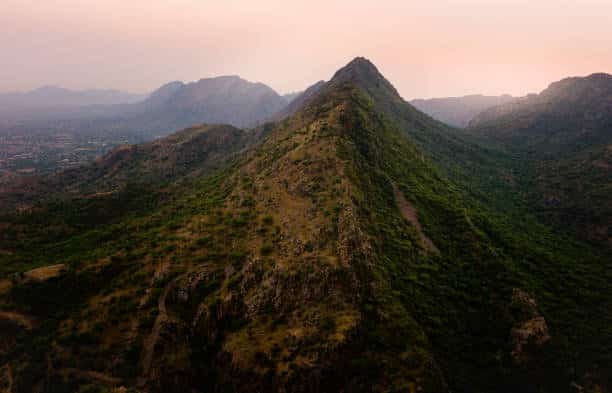
Where Is the Aravalli Range Located?
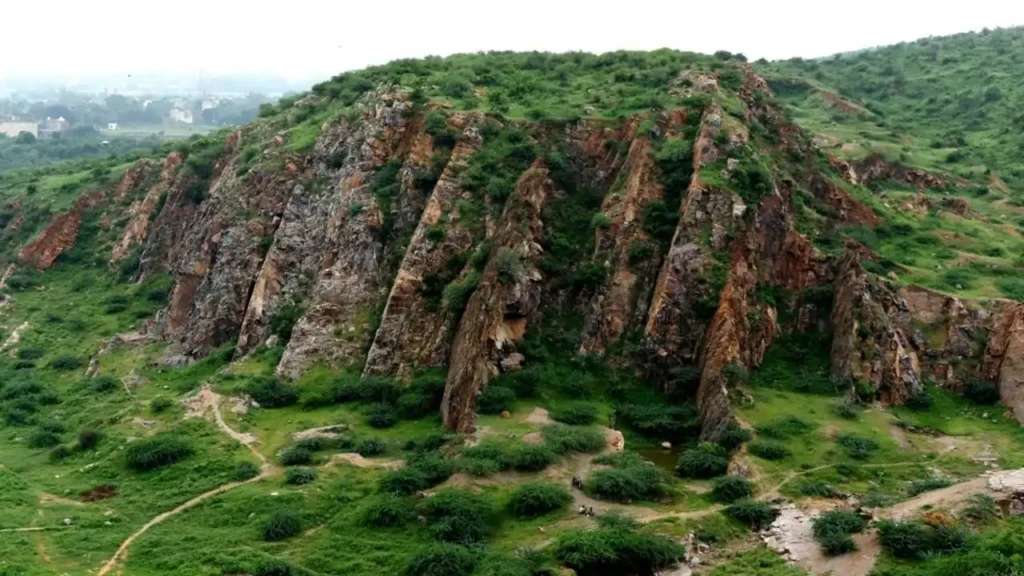
The Aravalli Range is a mountain range in northwestern India that extends almost 692 to 800 kilometres from Himmatnagar in Gujarat to Delhi via Rajasthan and Haryana.
By looking at the Aravalli Hills Rajasthan map, one can understand that the major part of the mountain range, which is about 560 kilometres long, is in the state of Rajasthan. It is the most substantial portion of the entire range.
The Aravalli Range Gurgaon is the area where the mountain range has its furthest extension in the north. It is getting into the Delhi–NCR region, whereas the southern point of the range is at Mount Abu, which is the location of Guru Shikhar, the highest peak of the Aravalli Range, with an altitude of 1,722 metres.
Geological & Geographical Significance
The Oldest Mountain Range in the World
The Aravalli mountain system is one of the oldest fold mountains in the world and is even older than the Himalayas. These ranges were formed about 2.5 billion years ago and are the leftover parts of the ancient orogenic movements that shaped the Indian subcontinent. The Aravalli Range was made up of rocks that were changed by heat and pressure, schist, and quartzite and was once as high as the Himalayas but has now worn away to low hills and ridges. Their height varies from 300m to 900m, though the land is quite different in Rajasthan and Haryana.
How Much Spread Aravalli Hills Cover and Its Height
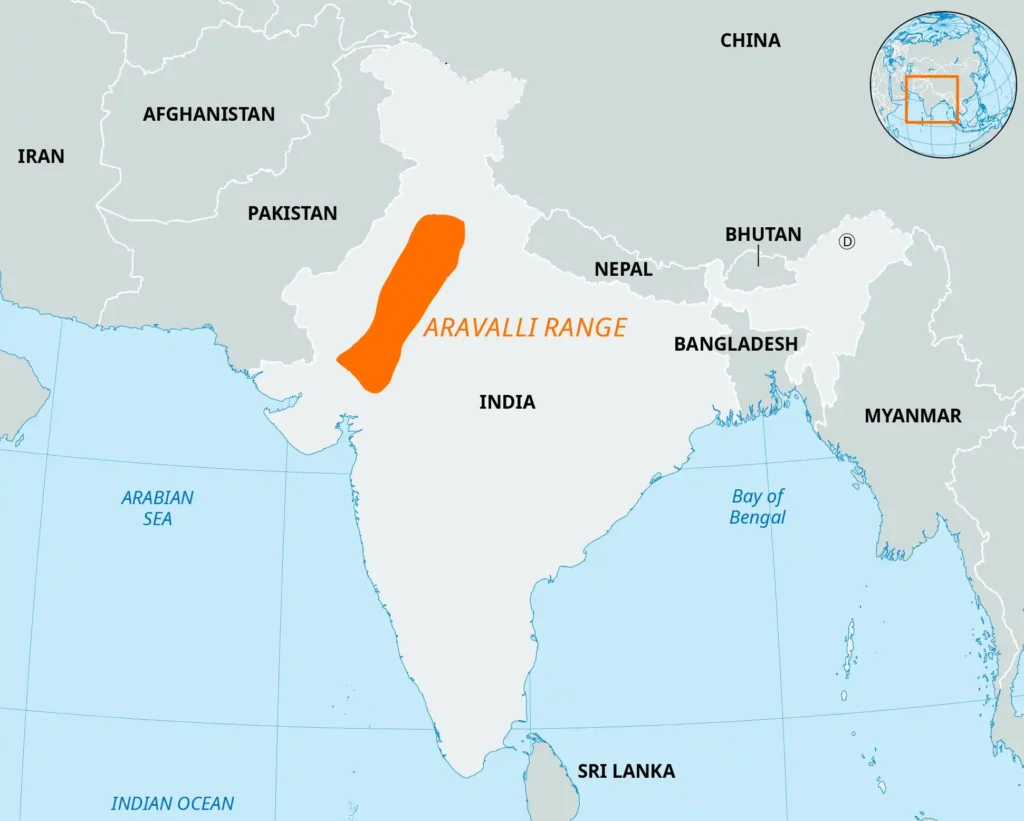
The Aravalli Hills spread across four Indian states — Rajasthan, Haryana, Gujarat, and Delhi.
- Total Length: Around 692–800 km
- Average Elevation: 600–900 meters
- Highest Peak: Guru Shikhar (1,722 meters) in Mount Abu, Rajasthan
These residual hills act as a natural divide between the Thar Desert and the fertile Indo-Gangetic plains, making them critical for India’s climatic and ecological balance.
Environmental Importance of Aravalli Hills Rajasthan
Barrier Against Desertification
One major contribution of the Aravalli Hills to the nature of Rajasthan is their protective function as a barrier against the Thar Desert. The mountain chain deflects the winds of the desert, and thus the sandy area is not allowed to move towards the east. Therefore, the rich agricultural areas of northern India are safe.
Natural Air and Water Purifier
The Aravalli hills, which are often referred to as the “lungs of Delhi-NCR“, remove carbon dioxide from the air, lessen the occurrences of dust storms, and renew the underground water reservoir by the process of rainwater infiltration. As a matter of fact, the rivers Luni, Banas, and Sabarmati take their source from these hills; thus, they are indispensable for the provision of water in the entire region.
Biodiversity Hotspot
The Aravalli Hills in Rajasthan are alive with 300 different native plant species, 120 bird species, and quite a few rare animals such as leopards, jackals, mongooses, and palm civets. But, by excessive mining and deforestation, the area that was stable has become endangered.
The Threats: Mining, Urbanization & Climate Impact
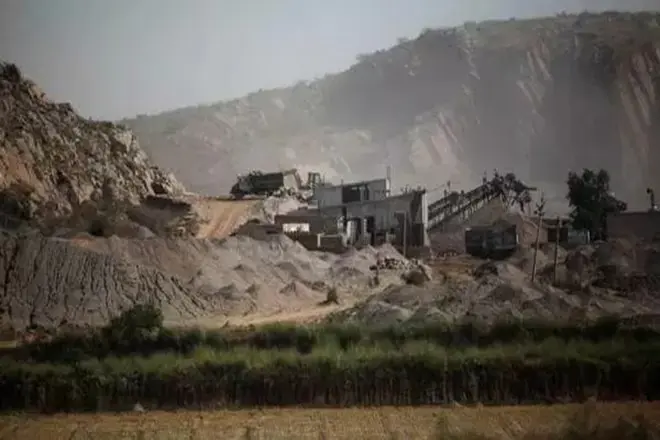
The Aravalli Hills are crumbling under the weight of human exploitation.
- Illegal mining: More than 25% of the hill ranges in Rajasthan have already disappeared due to illegal quarrying.
- Deforestation: Forest cover loss has worsened desertification and groundwater depletion.
- Urban pressure: The Aravalli Hills Gurgaon and NCR region are under immense stress due to real estate projects.
- Air pollution: Mining and construction contribute heavily to particulate matter (PM10, PM2.5) in Delhi-NCR’s already toxic air.
The Supreme Court’s Stand on Aravalli Hills Rajasthan
In recent years, the Supreme Court of India has played a crucial role in protecting the Aravalli Hills Rajasthan, though not without controversy.
The New Definition Debate
The Supreme Court agreed to a revised definition put forward by the Ministry of Environment, stating that the Aravalli Hills should be considered as natural features that rise 100 metres above the surrounding area. The redefinition has been criticised as it allows the protection of only those parts that account for less than 10% of the whole range, while the rest may be opened for mining and construction activities again.
Key Points from the Court’s Action
- Definition Change: Only hills rising 100m or more above local relief are now considered part of the Aravalli Range.
- Sustainable Mining Plan: The Court ordered a Management Plan for Sustainable Mining (MPSM) before any new leases can be issued.
- Temporary Ban: All new mining leases remain banned until the MPSM is finalized.
- Environmental Concern: Experts warn this could harm groundwater recharge zones and increase desertification in Delhi–NCR.
This change contradicts the Forest Survey of India’s broader classification, leading to a heated debate between development and environmental conservation.
Supreme Court Orders & Conservation Timeline
| Year | Action Taken |
|---|---|
| 1992 | Central government approval made mandatory for mining in the Aravalli region. |
| 1996 | Ban on renewing mining leases within 2–5 km of Badkhal Lake. |
| 2002 | Complete mining ban in Haryana’s Aravalli due to large-scale degradation. |
| 2009 | Ban extended across the entire Aravalli range. |
| 2018 | Ordered demolition of illegal residential complexes in Aravalli forest zone. |
| 2023–24 | Accepted new 100-meter relief definition; controversy continues. |
Aravalli Hills Rajasthan – A Lost Heritage
New Rules Threaten Aravalli Range: 90% Hills May Lose Protection What used to be a vibrant ecosystem and a cultural icon, the Aravalli Hills in Rajasthan, are now going through a level of devastation that is close to being irreversible. The Aravalli Range in Gurgaon has been deforested for the most part due to the rapid urbanisation that has taken place in the natural forests of its areas, whereas the portions of Rajasthan are experiencing soil erosion, pit lakes, and loss of habitat.
The Aravalli hills are a series of mountains located in Rajasthan, which is a state highly reliant on them not only for the continuation of the natural biodiversity but also for water, the monsoon, and the livelihood of the people. To lose them would be tantamount to advancing the desert from the outskirts into the central part of India.
Way Forward – Restoring the Aravalli Range
1. Adopt a Unified Conservation Policy
All four states — Rajasthan, Haryana, Gujarat, and Delhi — must implement a joint conservation framework under the Ministry of Environment to ensure consistent protection.
2. Promote Eco-Tourism
Responsible eco-tourism around Aravalli Hills Rajasthan can generate jobs while conserving the landscape.
Mount Abu and Aravalli Hills Gurgaon Biodiversity Park are great examples of this model.
3. Strengthen Green Wall of India Project
The Green Wall Project, spanning 1,600 km from Porbandar to Panipat, should focus on reforesting degraded Aravalli stretches using native tree species.
4. Ban Illegal Mining Permanently
Strict enforcement of Supreme Court orders and NGT guidelines is essential to stop unscientific mining that damages aquifers and terrain.
5. Water & Soil Conservation
Traditional rainwater harvesting systems, check-dams, and soil restoration can help recharge groundwater across the Aravalli hills Rajasthan distance belt.
Why the Aravalli Hills Matter More Than Ever
Losing the Aravalli Range means losing:
- Natural defense against Thar Desert expansion
- Rain and groundwater recharge zones
- Clean air buffer for Delhi-NCR
- Habitat for hundreds of species
- A living symbol of India’s geological past
Conclusion: The Hope Beyond the Horizon
The Aravalli Hills of Rajasthan aren’t just one of the four major mountain ranges of peninsular India —they are the age-old lungs of northern India, the home of the oldest known human culture, and the heart of the land.
After a long and continuous destruction for several decades, nature still has the power to heal. By court vigilance, mining in a responsible way and involvement of the citizens, we will be able to revive this heritage that we have forgotten so much.
FAQ,s Frequently Asked Questions
1.Where is Aravalli Range located?
The Aravalli Hills Rajasthan are located in the north-western part of India, stretching across Rajasthan, Haryana, Gujarat, and Delhi. This mountain range serves as a natural barrier between the fertile plains and the Thar Desert, playing a critical role in ecology, groundwater recharge, and climate regulation.
2.How much does the Aravalli Hills Rajasthan spread?
The Aravalli Hills Rajasthan stretch over approximately 692 kilometers, with the main ranges—the Sambhar Sirohi Range and the Sambhar Khetri Range—extending around 560 km within Rajasthan. This makes it one of the oldest mountain ranges in the world, crucial for biodiversity and water resources.
3.What is the height of Aravalli Hills?
The average height of Aravalli Hills ranges between 300 to 900 meters, with the highest peak of the Aravalli Range being Guru Shikhar, standing tall at 1,722 meters near Mount Abu. These elevations make it a prominent geographical and ecological feature of Rajasthan.
4.What is the Supreme Court action on Aravalli Hills?
The Supreme Court action Aravalli Hills involves strict regulation of mining, deforestation, and construction. Recently, the court adopted a new definition of Aravalli Hills—landforms rising 100 meters above local terrain—and mandated the preparation of a Management Plan for Sustainable Mining (MPSM), aiming to protect groundwater, biodiversity, and prevent desertification in the NCR region.
5.Where is Aravalli Range Gurgaon located?
The Aravalli Range Gurgaon, part of the northern extension of Aravalli Hills Rajasthan, spans Gurgaon and southern Haryana. Moreover, these hills act as the city’s green lung, recharge groundwater, and help reduce pollution and dust in the NCR.



 Free
Free