
Investment in agricultural land in India is gaining momentum among investors who have a long-term view of getting returns. As the city population increased, and the government had incentives to purchase agricultural land, selling the agricultural land is a wealth-generating opportunity as well as a tangible and safe investment. It is important to know the legal structure, types of land, and the trend of the market to make wise choices.
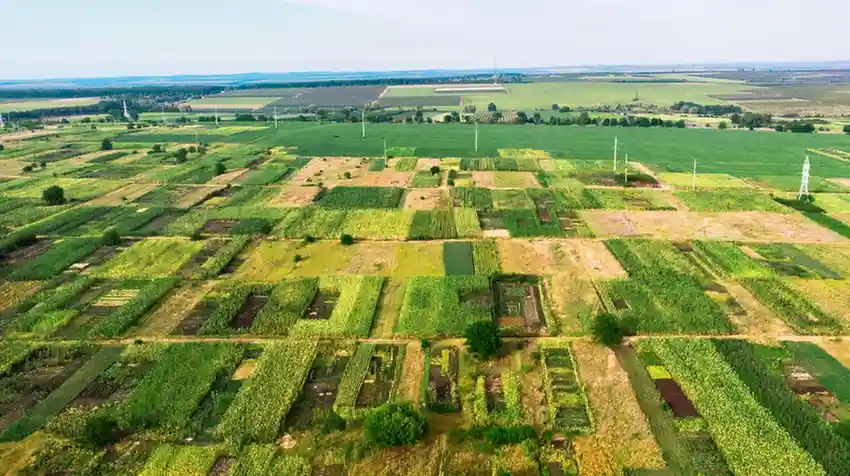
Why Indian Agricultural Land Investment?
The Indian agricultural land offers the following:
Long-term appreciation: The property value of land increases continuously, particularly around cities and semi-urban areas.
Tax benefits: Agricultural income is tax-free under the laws of India in most cases.
Tangible asset: Unlike stocks, land is a tangible physical asset that does not lose its value.
Lifestyle and sustainability: Depending on their needs, the investors may be in the land to farm organically, horticulture, or to have personal retreats.
It will only make sense to invest in agricultural land prescriptions so as to get more yields in the form of production or resale. In the majority of cases, bigger parcels in and around cities or industrial belts can be better appreciated.
Knowledge of Agricultural Land Area.
The size is important when determining the agricultural land. The area is measured in acres or hectares, and it is the area that dictates the usability and price. Smaller plots are simpler to control but slow to appreciate, whereas bigger areas can be used to carry out more agricultural tasks or sell better after resale.
Tips: Check land records and make sure that the agricultural land size one is purchasing is legally acceptable for the purpose one is planning. This eliminates a possible future legal tussle and a hassle-free transfer of ownership.
Where to Find Agricultural Land to Sell.
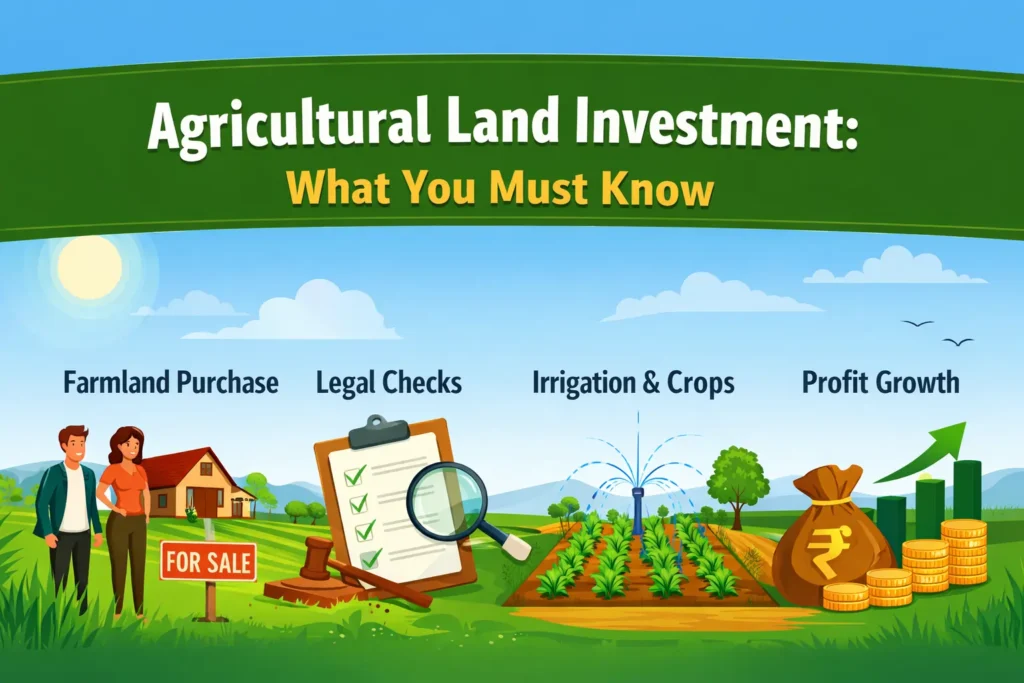
To locate agricultural land to sell, thorough research is necessary. Here’s a step-by-step guide:
Listings online: Sites that list properties focused on farmland have verified properties.
Local brokers and Landowners: In most cases, local brokers and landowners are aware of concealed opportunities.
Legal verification: This is to be done to ensure that the land is free of encumbrances, with clear titles, and appropriate land-use classification.
Government programs: There are rural schemes in some states where agricultural land is put under development schemes.
More sources increase the possibility of identifying the right property. Target fields where agricultural land in India is receptive to increase.
If you think to purchase Agricultural land, you can call and connect with our Land Aggregator Expert.
The Lowest Agricultural land in India.
India has the cheapest agricultural land, which can be located in less developed or remote regions for those investors who are low-budget. Although the prices are lower, such lands might need more infrastructure to invest in water and irrigation, and access roads.
Sample includes: Rajasthan, Madhya Pradesh, and some of Odisha and Chhattisgarh, which usually possess inexpensive agricultural land. The early investment in these areas can be very productive when the surrounding areas become developed.
Advice: Trade off between cost and connectivity and appreciation possibilities. The cheapest of land can be difficult to sell in the future in case of low demand.
Agricultural Land Investment Legal Issues.
Before investment, it is important to check the following:
Eligibility: Most of the states limit the ownership of agricultural lands to registered agricultural workers or residents.
Conversion of land use: Non-agricultural projects need the approval of local authorities.
Title inspection: No outstanding disputes, liens, or encumbrances.
State-based laws: There are laws in India that vary. Always seek the advice of a local lawyer.
Through these steps, your investment in agricultural land would be safe and profitable.
Advice on How to Get the Highest Returns.
Purchase close to urban development patterns: The land in the area adjacent to cities will increase in value more quickly.
Invest in land that is already prepared to irrigate: Preferred to have increased agricultural output.
Use government programs: There are certain programs that have tax incentives or subsidies.
Portfolio diversification of land: Various states or agricultural land types.
Such strategies guarantee short-term income and long-term capital gains.
Conclusion
One of the clever ways of building wealth in India is to invest in agricultural land. With the knowledge of the area of agricultural land, the legal regulations, and market dynamics, you can make a wise choice. Both newcomers and experienced investors have a chance to search for the areas of growth and the cheapest available agricultural lands and buy them.
In addition to making a good investment in agricultural land development, it can also enhance sustainable farming and rural development, and this is a well-planned agricultural land investment. Early start, check the legality of the land, and see your investment grow.
FAQs
FAQ 1: What are the agricultural lands and their status?
Answer: Agricultural land is real estate that persons use their land to farm, plant, or keep animals. It is frequently controlled by state legislations in such a way that it is committed to farming. This assists in preserving farmland against non-agricultural, inappropriate use.
FAQ 2: What is the difference between agricultural land and non- agricultural land?
Response: The agricultural land is intended to be under farming activities, whereas the non-agricultural land can be utilized in building houses, industries, or even in business. Notably, agricultural land has to be converted with the support of local authorities.
FAQ 3: What are the agricultural land prices in India?
Response: Land prices are determined by the quality of the soil, access to water, and accessibility to cities. As an illustration, 1 acre of agricultural land in India may be more expensive in the vicinity of towns. In Maharashtra, the state authorities control the land rates, and this depends on the district.
FAQ 4: Do you have restrictions on the purchase of agricultural land in India?
Answer: Yes, land ceilings are imposed by states on the amount of land one individual or family is allowed to own. In other areas, purchasers must be registered farmers. As such, you are not free to purchase large parcels without fulfilling the legal requirements.
FAQ 5: What are typical units and types of agricultural land?
Answer: It is common in use where the land is measured in acres, bighas, or killas, but measurement varies among regions. The agricultural land is classified by irrigation (rain-fed or irrigated) or the type of crop (horticulture, timber, or food grains), which assists the investor to plan the usage of such a land.





 Free
Free